Building Applications with React and Flux
It’s live! I just published a new course on Pluralsight: “Building Applications with React and Flux“. This is the product of over six months of preparation including the creation of a rich demo application that implements the core features of React, Flux, and React Router. This course also utilizes a modern JavaScript development environment that includes Node, Browserify, and Gulp. To help get you started, I’ve created the React and Flux starter kit. Simply download the starter kit, type “npm install”, then type “gulp”. Then you’re all set to follow along with the course!
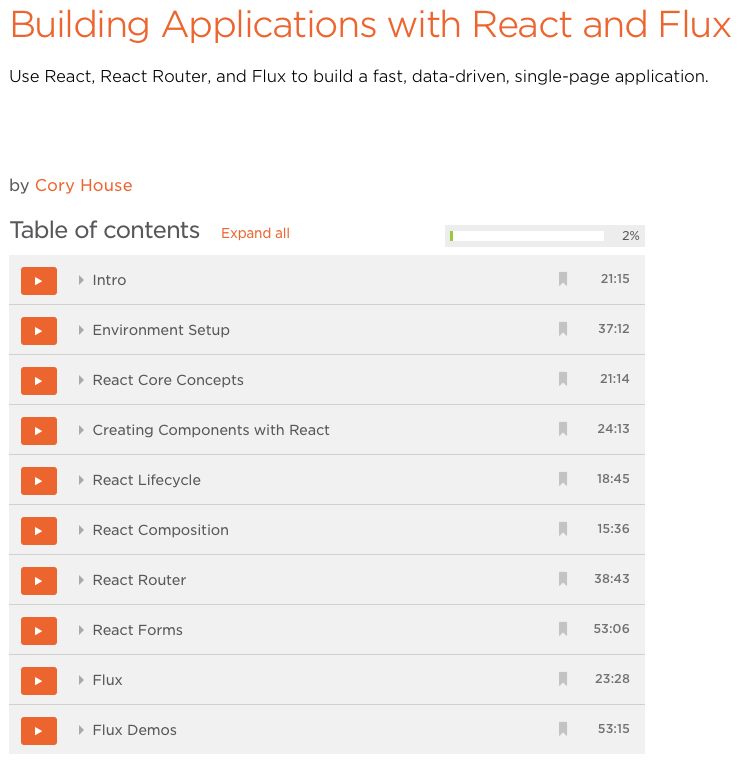
I couldn’t be more excited about building applications in React. It’s the most fun I’ve ever had doing front-end development yet. If you’re curious, I hope you’ll give the course a look!
Comments
Kevin O’Shaughnessy — 2015-08-14
Congratulations Cory. Sounds like a fantastic course. I’ve added it to my bookmark list to watch soon.
Cory House — 2015-08-14
Thanks Kevin! I look forward to hearing your feedback!
Paul — 2015-08-24
Just finished the course on Pluralsight! I found it to be very well paced and easy to follow 🙂 Thank you for your time and effort!
Are you interested in maybe making a course on CQRS & Event Sourcing in Microservices with Node? 🙂
Bryan — 2015-08-24
Hi Cory,
Thanks for putting this course together. As a newbie to the world of JavaScript and React, I found it very helpful to gain an understanding of the concepts, especially through the use of examples.
I was working on completing the challenge at the end of the final modules and was wondering if you were planning on posting a potential solution. The part I would be most curious to see is how to properly create an author dropdown as a reusable component when the author data coming from the Course API is an object as opposed to just the author ID.
Stuart — 2015-09-25
When I went to Pluralsight I tried browsing for the course by using “react” and “cory house”. Your course was never listed. Had I not read this blog I might never have found it. Thought you should know.
Vivek Ragunathan — 2015-11-10
Hi Cory
I am half-way through the course and I am liking it a lot. It is proving to be very useful for me. Actually I started a React application before the course. It was itching in my mind if what I was doing the right, the React way. Your course and the way it is organized helped me understand and change certain parts of my application.
I have one question about the “Redirects” chapter. When you define routes in JSX (which ultimately is going end up on the client side as JS), how does the redirect happen when you hit an (old) url from the browser? For instance, when type the url “…/about-us” in the browser, it sends the request to the server. How would the server know to redirect to “…/about” if the redirect is in JSX? If the redirect is setup on the server, what part of JSX gets executed on the server?
I know I am missing something basic. So bear with me if the question sounds silly.
Can’t wait to finish the course, and expecting more such courses.
Thanks
Vivek Ragunathan
Adam Seldon — 2015-12-18
Hi Cory,
Am about half-way through the course, and it is excellent. However, you quote above:
“This course also utilizes a modern JavaScript development environment that includes Node, Browserify, and Gulp.”
Whilst this statement is not incorrect per say, it could be argued that actually a modern JavaScript development environment would include Node, Webpack, Babel, and ES6 / ES7.
As I say, really enjoy your course, and your teaching style is excellent (5 stars). However, as I complete each “module / chapter” I am converting everything to work with Webpack and ES6. Appreciate you mention early in the course your decision to stick with ES5 syntax – just feel the exclusion of webpack and es6 was a little misguided. In any case, let me know if you’d like a copy of the updated course materials when I have finished and be happy to share. It makes quite an interesting and interactive challenge doing the port / migration work in any case 🙂